Tuesday, April 7, 2015

Toxin Tuesdays: Nicotine

Keep nicotine containing products away from your pets (Image Source)
Nicotine and tobacco are toxins that many pets will have easy access to and therefore it is not uncommon to see side effects. Overall tobacco only poses a mild to moderate risk to our pets. However, it is still a very good idea to keep our pets away from the products.
Nicotine is can be absorbed very quickly from the small intestines. This means side effects may occur as soon as one hour after ingestion. Something else to consider is some products (such as some of the gums) may have xylitol in them which is MUCH more serious than the tobacco in them. It is important to know what products your pet may have been exposed to so appropriate treatment can be initiated.
 
Both of these products can pose a risk for our pets (Image Source)
Possible side effects include vomiting, increased salivation and diarrhea. These are the most likely to occur. We may also see an increase in heart rate and blood pressure. After the initial excitement and hyperactivity we may see a significant decrease in activity and in heart rate. In many cases the symptoms could be self-limiting and resolve within a few hours. This will depend on the product that was consumed and how much of it. In extreme cases it hospitalization may be necessary for the first day. Regardless, if you know your pet has gotten into a product containing nicotine it is best to contact your veterinarian to determine if further action is needed.
 
Nicotine containing gum can add extra hazards as some contain xylitol which is toxic to pets. 

Overall if the exposure was a lower dose of nicotine and NOT something that included xylitol, then the prognosis is usually pretty good. If the exposure was very high, had additional products (such xylitol) then hospitalization and supportive care may be necessary. The important thing is to keep products like this away from your pet and if accidental exposure occurs call your veterinarian immediately. 

Friday, April 3, 2015

Breed Focus: Corgi

Small in size but very regal in appearance (Image Source)
The Corgi is a breed that has gained wide recognition because they are the preferred pet of the British Queen. This is a very active dog, that although small in size is mighty in spirit! You will need to be ready to keep your Corgi busy should you welcome one into your family. They also like to take part in all family activities and help ‘supervise’. Due to their herding tendency they may try to round up small children and enjoy nipping at their ankles. It is best to start a training program as soon as you bring your Corgi home.
 
What a cutie! (Image Source)
This is a dog that will shed and may need to be brushed to help pull out some of their undercoat, however regular grooming appointments are not necessarily required. Although they are active they can definitely be trained and excel in many different activities in the dog world. For example, many Corgi’s achieve thrive in agility courses. Their energy, intelligence and small size make many of the challenges seem easy.
 
Their energy can get them into trouble so make sure you have a good outlet for them! (Image Source)
There are a couple of health conditions to be aware of as you are looking into the Corgi breed. One is that due to their long back they (like dachshunds) tend to be prone to inflammation between the vertebral spaces. At a minimum it can cause discomfort, but if progresses can lead to permanent paralysis. Another condition that is known to be genetic (passed from parents to offspring) is degenerative myelopathy. This is a very serious condition that will lead to irreversible paralysis. The good news is that there is a blood test that can be run on the parents to ensure they are clear or if they are carriers. When researching breeders it is a good idea to make sure they have had the appropriate testing done.  
 
With a little training they can do some amazing things (Image Source)
Overall this breed is fun loving and wants to be a big part of your family. With appropriate training they can truly enhance your life, especially if you are already used to a lot of activity. For more information on this breed please visit the following websites here and here.  

Thursday, April 2, 2015

Doodle Days #45

These are the items necessary to keep me clean and healthy! Ear flush, comb, and dental wipes (oh and a few marshmallows if I'm good)
Hi Everyone! I wanted to give you a little peek into my life. Wednesdays are a rough day for me. Well I guess I am a little torn on this. See on Wednesdays, I get my hair brushed, my teeth brushed and my ears cleaned. (although I hear in April we are making it a goal to brush my teeth every day). Now while I don't mind any of these activities per se....they are not my favorite.
I have resigned myself to getting my ears cleaned and combed. 
We start with the cotton ball of ear flush in both my ears. 
Then we wipe them dry!
Then marshmallow for good behavior!!
The bright side is, I get rewarded for good behavior. (Side note: my favorite person would like me to remind you that I do NOT get the whole bag of marshmallows, and that all treats should be given in moderation and definitely check with your veterinarian before giving people food!)
Brush Brush Brush...it has been windy so I had a few snarls. 
While I do look handsome after brushing, I like the wind blowing through my ears too much to stay this way. 
I get marshmallows after my ears are cleaned and another after my hair is brushed. I LOVE LOVE LOVE the dental wipes so licking them after my teeth are brushed is all the reward I need.
I actually like having my teeth brushed, but it is sometimes difficult to keep myself from licking the wipe!
If I'm really good I get to lick the wipe for as long as I want when we are done cleaning my teeth!
 I also thoroughly enjoy itching my head on the carpet after the hair brushing is over. I prefer more of a wind blown look to my hair.
Being clean makes my chin itchy, so I roll around on the carpet once all this excitement is over!
After a few minutes of itching I'll be back to my normal self!
Well that is a small look into my week! Hope everyone has enjoyed the nice weather!

Wednesday, April 1, 2015

Cataracts

Anatomy of the eye (Image Source)
Cataracts are a condition affecting the eye that many people may be familiar with due to its prevalence in humans. The eye itself is a fairly complex structure however cataracts only affect one part, the lens. The lens is used to focus the eye on a specific image. Cataracts are a distinct opacity on the lens that affects vision. It can encompass a small part of the lens or the entire lens. If the entire lens is affected the patient will be blind in that eye. There is another condition that can affect the lens called nuclear sclerosis. This is just a clouding that occurs on the lens as pets age. They are still able to focus and see through this area where as cataracts they cannot.
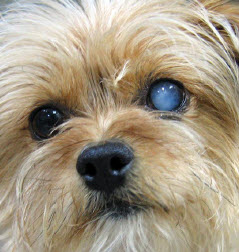
In this pet only the left eye is affected with the cataract. (Image Source)
There are several ways pets can develop cataracts. One is that they could be born with the condition. Many times this will only be a small portion of the lens so they can still retain some vision in that eye. There is also a genetic link to cataracts so if purchasing a puppy it is a good idea to make sure the parents have had their eyes checked by a veterinarian. Another cause is diabetes. Almost every dog with diabetes will develop cataracts at some point in their life.
Surgical correction is an option for some pets but will require a full work up to ensure they are a good candidate (Image Source)
Cataracts by themselves do not cause any serious issues (aside from loss of vision). However as they progress or if any movement of the cataract occurs, it can lead to pain and inflammation. In some cases the cataract can block fluid from leaving the eye which can cause a secondary glaucoma ( a spike in the pressure in the eye) which is extremely uncomfortable. If your pet has cataracts regularly checkups with your veterinarian will be a good idea as well as monitoring at home to make sure your pet remains comfortable will be important.
In this dog, both eyes are affected. (Image Source)
There is a treatment for cataracts which involves surgically removing the defect. However this can be very invasive and not all patients are good candidates. Many times this will require referral to a veterinary ophthalmologist to determine if surgery is a good idea for your pet. Most owners elect management. This means actively monitoring for any secondary side effects (increased pressure, redness or inflammation) and treatment them before they get out of hand. Although it does affect their vision, many pets will adapt to the decreased eyesight especially if it is a slower onset. IF rapid blindness occurs, behavioral modification may be necessary to make sure your pet feels comfortable and safe now that they have lost one of the senses.  For more information on cataracts please visit the following website here

Tuesday, March 31, 2015

Toxin Tuesdays: Bread Dough

Bread dough can cause more issues in our pets than you make think! (Image Source)

Bread dough may not seem like something that would classify as a toxin, but in our pets it can cause some serious side effects. While pets can be exposed to bread dough any time there seem to be spikes around holidays (Easter, Christmas, Thanksgiving, etc) as more people are making things from scratch. As pets ingest the dough, it will begin to rise in the warm, moist contents of their stomach. This will cause gas to be released and can lead to some of the clinical signs we see.
Best to keep pets away when cooking! (Image Source)
The most common side effect of ingesting uncooked bread dough is vomiting, bloating or most severely flipping of the stomach (GDV or gastric dilatation and volvulus). Other side effects can include an increased heart rate and hyperactivity, some pets will vocalize while others may become very depressed. Many times as the condition progresses they will become weak.  If you pet has a bloated stomach or is trying to vomit with nothing coming up this is an emergency and they should be seen by a veterinarian right away. (For more information on bloating and GDV please visit the following website).
Although they may want to help or sample your cooking, it is best to avoid uncooked food! (Image Source)

When presented to the veterinarian they will likely want to run blood work to assess electrolytes and glucose levels and also take x-rays to assess the stomach or look for a foreign body obstruction. The bread dough can be rapidly absorbed so if the patient is already symptomatic or we are unsure when the exposure occurred your veterinarian may not recommend inducing vomiting. In an emergency situation sedation may be necessary and a cold water lavage (where cold water is pumped into the stomach) can help decrease the rate at which the bread is absorbed and fermenting.
Accidental exposure to uncooked bread dough may make your pet feel sick! Get them to the veterinarian right away! (Image Source)
With aggressive and quick treatment most dogs will experience a full recovery. If the case becomes more complicated such as a progressing to a stomach torsion. Recovery can take much longer and may have a slightly worse prognosis. If you are baking especially around the holidays, make sure your pet is directly supervised or confined until all baking products are put away! 

Friday, March 27, 2015

Breed Focus: Boston Terrier

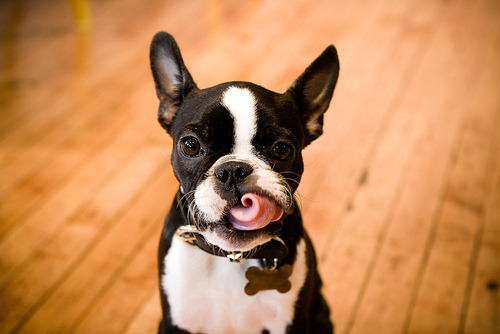
If you welcome a Boston Terrier into your home it is very likely you will both have very big smiles all the times (Image Source)
The Boston terrier is a small breed dog that packs a big and loveable personality! They can be the clown of the party if you let them! Their small size yet sturdy build lends them to many different living environments, but they will need regular exercise to harness some of their energy. They were bred in Boston (surprising I know!) and seem to adapt well to active or slower life styles. They require little in the way of grooming which makes their up keep fairly simple.
 
They will definitely add a little humor to your life! (Image Source)
There are several health concerns to be aware of prior to brining a Boston terrier into your home. For starters, they are considered a brachycephalic breed, which means their noses are slightly sunken in and they can have difficulty breathing. They also possess very large eyes which can make them more prone to ocular injuries. As with many other small breeds they are also prone to luxating patellas. This is where the knee caps are not secure in their location and can move in and out of joint. Overall though this breed tends to be fairly healthy!
 
Even as puppies they will take on just about anything! (Image Source)

Boston’s are such a versatile breed that they make a great addition to most families. Their abilities range from a calm therapy dog to an active agility dog dominating in the show ring! They seem to adapt to whatever life style their family has for them. As with most puppies it will still be important to socialize and go through basic training to make sure they continue to be a well-adjusted pet. But if you let them they will keep you and your family laughing for hours with their crazy antics and wonderful personality. For more information please visit the following websites here and here

Thursday, March 26, 2015

Doodle Days #44

The other day I was sleeping minding my own business (waiting for spring...I miss the outdoors!)
Just relaxing, trying to get some shut eye!
Then my people had the idea to get me to balance on my back legs! 
Look I'm balancing!
I did pretty well for awhile, and then all of the sudden. 
Still balancing....
I fell....it was a little embarrassing but I survived. Hopefully I can struggle through a few more days and then spring will come and I can frolic and find entertainment for my people elsewhere besides teaching me new tricks. 
Whoops! How embarrassing...