Thursday, April 14, 2016

Product Focus: Hill's Prescription Diet C/D Multicare Stress

There are a lot of products and medications available for your pets. How do you know what each one is for and if it is the right choice for your pet? The best way is to ask your veterinarian! We are also going to take a look at certain products and what the do and what possible side effects they may have. The more information you have, the better decisions you can make for your pet!

This is a great new option for cats with urinary issues! (Image Source)

Today we are going to look at a prescription diet for cats. It is called C/D Multicare Stress. Although it is a long name, it also comes with a long list of benefits. Many pet owners shy away from prescription diets as they are afraid of the price tag that comes with them, however these foods have been thoroughly studied to provide the results they claim. In fact, most prescription diets come with a 100% guarantee that you can get your money back if your pet does not like the food or you are unhappy with the results. Talk to your veterinarian that has prescribed the food to make sure this is an option for you!
This balanced diet is safe for all adult cats to eat! (Image Source)

C/D Multicare Stress is designed to help address one of the biggest problems we see in our indoor cats. That is urinary issues. This could be cats that urinate outside the box, cats that are straining in the litter box or in emergency situations cats that cannot urinate. There are many reasons cats may struggle with litter box issues. Your veterinarian will likely recommend testing to rule out urinary tract infections, urinary stones or kidney disease. Once the reason for the urinary issues has been established, many times a dietary change can become an important part of therapy.
There are some really great ingredients that can help your 

The great thing about C/D Multicare Stress is that it can help with many of these medical issues but can also help with some behavioral components. One great aspect of this food is that in some cases, it can dissolve struvite stones (a common stone that cats can develop) within seven days. It also works to prevent the development of the certain stones. Many cats will with urinary issues will have an underlying issue with stress. This could be from their environment or internal stress. C/D Multicare Stress is designed to help combat this as well. Ingredients such as tryptophan (like what is found in Turkey!) can help your cat to relax. Omega 3 fatty acids can also help calm down certain inflammatory processes throughout the entire body. When used in conjunction with environmental enrichment strategies you could see a much happier and well-balanced feline!

We want our all feline friends to be this happy and sometimes a prescription diet can help! (Image Source)

Prescription diets can be a very valuable part of treating and managing certain conditions in our pets. To learn more about C/D Multicare Stress, you can visit their website here. If your cat is having issues with the litter box, we would definitely recommend a visit to the veterinarian. For information on Feline Cystitis or other urinary issues you can visit veterinary partner's website here.

Friday, April 1, 2016

Happy Visits!

Some pets are really intimidated by the vet's office, here are some ways we can help! (Image Source)

It is no secret that many pets do not like coming to the veterinary clinic. We joke sometimes saying they have white coat syndrome, but this can actually be quite serious. It is sometimes the reason many of our pets (especially cats) do not get the routine care they need. Owners begin to feel bad that their pets are so scared and stressed when they come to the clinic, so many times it is avoided all together. While there are options in some areas for house visits or mobile veterinary services, that is not always possible. So what can be done to help our pets? One option is considering happy visits!
We can't blame our pets for being scared, but we can help make veterinary visits a little less stressful (Image Source)

What is a happy visit? A happy visit is when your pet comes in and doesn't have anything painful or scary done to it. Maybe we give some treats, maybe we play with a favorite toy. Whatever your pet likes we make that happen at the clinic. Depending on your pets stress level, this will determine how involved the visits need to be. For example, if your pet is stressed before it even gets in the car, we need to work on desensitizing your pet to the car ride (or carrier for cats). Leaving the carrier out year round so your cat is used to it can make travel much easier. You can also offer treats and toss toys in there throughout the year so it is not a scary place. If your dog is scared of the car, reward them every time they go near it, maybe they get half of their meal near the car, and slowly work your way up to just sitting in the car and getting back out. Then over time (and each pet is different so this could be weeks or months) you start driving to different places and rewarding them.
Treats and special rewards can help make visits a little less stressful! (Image Source)

Sometimes our pets may need a little more help than just treats and rewards. There are products available that can help! Phermone sprays such as Feliway and Adaptil can help calm anxious pets when used appropriately. There are also supplements, such as Composure Pro, that help relax your pet without sedating them or having any harmful side effects. Sometimes we need to do a combination of therapies to help calm anxious pets. It is important to remember that patience and hard work pay off! Definitely ask your veterinarian for their recommendations.
When pets are more relaxed, it makes everyone happy! (Image Source)

Once the pet gets to the clinic we may start small just offering treats and letting them leave. Or maybe getting them on the scale is a challenge, so we work on treats and petting or special rewards near the scale. Overtime maybe we have them visit with the doctor or technician so they get used to strangers handling them. This will help when they need to come in for a medical appointment to make the clinic less intimidating.
This pug seems ok with his examination! (Image Source)

It is important to know what motivates your pet. In some instances it may not be food but rather play or exploration. We have one special kitten that didn't seem too interested in treats, but loved his toys. So with every nail trim we set aside time for him to play/ explore our exam rooms. While he may never love coming to the clinic and getting vaccines, he is definitely not intimidated and not fighting his owners to get here. That is a win-win for everyone.
While not all patients will be this relaxed, we can definitely make them more comfortable with each visit! (Image Source)

Although happy visits may take a little bit of time and commitment, they will reap huge rewards for your pet in the future. If you are stopping in to pick up their monthly flea/ heartworm or just driving by we always encourage you to stop in with your pet, in hopes of making their next visit less stressful.

Tuesday, March 29, 2016

Product Spotlight: Trifexis

There are a lot of products and medications available for your pets. How do you know what each one is for and if it is the right choice for your pet? The best way is to ask your veterinarian! We are also going to take a look at certain products and what the do and what possible side effects they may have. The more information you have, the better decisions you can make for your pet!

Today we are going to look at Trifexis!
Trifexis is a great option for dogs to help prevent common parasites (Image Source)

Trifexis is a tablet for dogs that helps prevent fleas and heartworms. It is recommended that this medication be given on the same day each month. Many dogs will find the taste appealing. Although it is beef flavored, it actually contains hydrolyzed soy as well as pork protein. This may help many dogs with specific food allergies. However, if your pet has known food allergies it is best to work with your veterinarian for a specific plan for you pet. Trifexis seems to be best tolerated when giving with a meal.
Trifexis has many jobs! (Image Source)

There are many benefits to Trifexis. One is that it has proven to work quickly against fleas. Many times within several hours of administration, you will start to see a large population of live fleas die off. Due to this fast action, adult fleas will be killed before they are able to lay eggs, which in turn helps decrease the population in your pet's environment. It is also very effective against preventing heartworm infestations. It is recommended that all pets be heartworm tested negative prior to starting heartworm preventatives and the American Heartworm Society recommends once yearly testing for all pets. You can find out more about the American Heartworm Society here. Another benefit of Trifexis is that it helps treat and control hookworms, roundworms and whipworms. These are some of the most common intestinal parasites we see in our pets.
These little tablets pack a big punch against common parasites! (Image Source)

As with many medications, there are some side effects to be aware of prior to giving this to your pet. The most common side effects including vomiting and diarrhea. If given with a full meal, it tends to decrease the likelihood of this happening.  Some pets may also exhibit lethargy (sleepiness) or itching on the skin. Anytime you are administering a new product to your pet, it is a good idea to monitor them for several hours afterwards. If you have any concerns please contact your veterinarian. For full review of safety and possible side effects you can visit the Trifexis website here.
Trifexis can come in many sizes, so you have the right fit for your dog! (Image Source)

Overall Trifexis is a great option for many pets. It can help prevent and treat some of the most pesky and serious parasites we see in practice. If you have any further questions be sure to contact your veterinarian. No matter what product you use make sure your pet is on year round flea and heartworm preventatives!

Monday, March 28, 2016

Disease Focus: Heartworm disease


It’s that time of year again.  The sun is shining, the flowers are blooming, and it means that mosquitos are going to start breeding and emerging as well.  Mid to late March is the time where veterinarians urge pet owners to get back into the routine of monthly heartworm prevention prior to the onset of mosquito season.  (We really recommend year round prevention).  I am surprised by how many clients are unaware of the true risk of heartworm disease, or the importance of monthly heartworm prevention given consistently.


What is Heartworm Disease?

Heartworm disease is a worm, an actual worm, that your pet can get from a mosquito bite.  When an infected mosquito bites your pet, it can inject baby heartworms, called microfilariae, into your pet’s blood stream with that bite.  These microfilariae go through several stages of maturation, and end up in the vessels of the heart and lungs as adult heartworms.  Heartworms don’t just stay put once they get there, and can cause a lot of damage migrating around your pet’s lungs.  As the amount of worms living in there gets larger and larger, they cause problems with blood flow.  Heartworm disease can cause lung damage and can ultimately lead to heart failure as well.


How does heartworm prevention work?

Regardless of what monthly heartworm prevention your pet is on, the heartworm prevention is meant to kill the microfilariae that your pet may have picked up by mosquito bites over the past month.  The medication does not stay in your pet’s system for a month, and can ONLY kill the “baby” stage of the worm, which is why the “monthly” timing is so crucial.

If you have missed a dose of heartworm prevention, but then resume it after that missed dose, your pet can STILL get heartworm disease, because that worm will mature past a stage the medication can kill, and keep maturing.  This is why your veterinarian will recommend yearly heartworm testing, even if your pet takes preventatives.

If you pet gets a heartworm, it can take six months before the test will show a positive result, because the heartworm testing can only detect adult heartworms.  So sometimes you can have a negative heartworm test one year, start prevention, and have a positive result the next year.

My pet stays inside, can he still get heartworms?

Indoor pets, and mostly indoor pets are still at risk.  We have all gotten mosquito bites while sleeping because a mosquito slipped inside.  Obviously the exposure to mosquitoes is reduced, but the potential is still there.  If you have chosen not to use heartworm prevention on your mostly indoor dog, a yearly heartworm test is even more crucial to try and catch any disease as early as possible.  Cats, indoor and outdoor, are also at risk, and are recommended to be on heartworm prevention.

What if my pet becomes infected with heartworms?


Pets that contract heartworms can be treated, but heartworms are really bad.  They can cause a lot of damage to your pet’s organs, and they are hard to kill.  Worse, is that the treatment is risky, and very costly, where the preventatives are not.  Your pet will need to go on a series of medications, and injections, and may require a few hospital stays in order to clear the disease.
                                    

Tuesday, March 1, 2016

Product Focus: Nexgard

There are a lot of products and medications available for your pets. How do you know what each one is for and if it is the right choice for your pet? The best way is to ask your veterinarian! We are also going to take a look at certain products and what the do and what possible side effects they may have. The more information you have, the better decisions you can make for your pet!

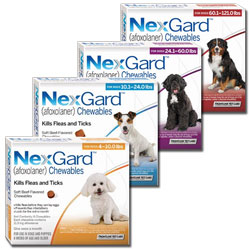
Nexgard is a monthly chewable that helps prevent fleas and ticks on your dog! (Image Source)

Today we are going to look at Nexgard!

As the weather is starting to warm up (we think!) it is time to starting thinking about flea prevention for your pet for the year. Nexgard is a wonderful new product that can help protect your pet from fleas and ticks.

Avoid fleas with this great (and delicious) monthly preventative (Image Source)

One of the most appealing aspects of this product, is that it takes the form of a delicious beef chew. Most pets think it is a treat and don't even notice they are getting medication. This makes remembering monthly flea prevention very easy. The company that manufactures this medication also makes Heartgard, so they two can be used together to have your dog fully covered for fleas, ticks AND heartworms. (Please note that it takes TWO separate products to cover all THREE of these preventatives. As of right now there is not a chewable product available that will prevent fleas, heartworms and ticks). Another great thing about Nexgard is you can give a bath anytime after (or before) administration. With topical medications, many times you need to coordinate the bathing schedule with the administration of the medication, however with Nexgard this is not an issue!

Most dogs love the taste, which makes giving it very easy! (Image Source)

While Nexgard is usually very well tolerated, as with any medication, there are a few side effects to watch out for. The most common includes vomiting or upset stomach. Nexgard does not have to be given with a meal, but sometimes giving the chewable after a meal will help prevent your pet from vomiting if they have a sensitive stomach. Several pets also seem to become a little sleepy after the medication is administered. This is usually temporary and they will be back to normal by the next day. Any time you are using a new product, it is always a good idea to observe your pet and let your veterinarian know right away if you have any concerns. For more information on the safety of Nexgard, you can visit the following website, here.

Who wouldn't want a delicious way to prevent fleas and ticks? (Image Source)

Nexgard (along with the Heartgard combination) has really made monthly flea prevention much easier. It is much more fun to give your pet something they enjoy eating and that will help protect them from pesky parasites. If you have any questions regarding this product, you can always talk to your veterinarian or visit the manufacturer's website here.


Wednesday, February 24, 2016

The Dangers of Waiting Too Long

Everyone does it.  You want to try things at home, try to solve the problem by yourself, maybe try to save a little cash; but sometimes the problem is just too big for home remedies, and a professional needs to be involved.  This is true in every aspect of our lives, from doing taxes, to fixing the plumbing, to your pets’ health.

Recently, I have seen a rash of these particular cases.  The potentially easily treatable cases that have now become medical nightmares.  These are some of the most feared cases to grace the veterinary appointment book.  We know you meant well, and that you were not trying to do any harm to your pet, but often some of these problems can get out of hand really quickly.


The skin case.  Regardless of the cause, skin cases can go from bad to worse over a small period of time.  Maybe you noticed a couple of spots of hair loss, or some mild itching originally.  First you invested in a lot of the over-the-counter products to see if you could manage the problem yourself.  Then those over-the-counter products helped just a little, just enough to give you the confidence that you had the problem well in hand, and then in the blink of an eye, a month has past, and your dog is covered in sores, or is bald.  Clients that may not have experienced this might laugh at this dramatic tale, but it really is something we, as veterinarians, will often face.  Unfortunately, by that point, the client is frustrated, and wants quick results, and the treatment and recovery time is so much more extensive.  Skin may seem like such a minor thing, but skin diseases can tailspin very quickly in our busy lives.


The urinating outside the box cat.  At first it doesn’t bother you.  Sometimes your cat pees outside the box, you use the cleaner, and you move on with your life.  But time and again, this problem becomes progressively worse, and you are really starting to resent the air that your cat is breathing.  You finally bring the cat to the veterinary office, dripping with scorn, with a sarcastic ultimatum of fix him or else.  Of course, we all love our pets, so we never get to that point, but you know where this is heading.  We promise, cats are never urinating outside the box out of spite.  Even if the veterinarian does not find a medical cause for this cat behavior, there are many other reasons for this concern, and we want you and your cat to live amicably together.  Its important in these cases not to let the frustration build to a terrifying level before you seek veterinary care for these cats.


The Fleas.  We know, everyone knows about fleas, everyone knows what to do about them, and Veterinarians only sell those expensive products to make extra cash.  Well, we promise you, the reason we sell those “expensive products” is because we trust they’ll work.  We don’t want fleas on your pet or in your home any more than you do.  You are wasting your money on those flea shampoos and flea dips, and house bombs, and over the counter topicals.  You will spend way less on veterinary products, and experience way less frustration, in the end.


Patient Spotlight: Meet Fusilli

We are so lucky to have some amazing clients and patients. I'd like to take some time over the next few months to acknowledge some of them.

Next in line is Fusilli!
This is the face of a very happy dog!

Fusilli is a very special dog, and his owner really summed him up great when she described him as 'sweet, loyal, obedient, goofy and so darn cute!'  It has really been a joy to get to know him as a patient and to watch him change and grow in his new home.

His story did not start out quite as happy as it is now. Prior to his current home he had been adopted and re-homed four different times! He is currently in his fifth home! That is a lot of change and stress for one little pup! He was adopted but his current owner from Vermillion County Animal Shelter in Tilton, IL. She had originally gone to look at another dog that had interested her from their Facebook page. Upon meeting that dog, it just didn't seem like the right fit for her household. She was about to leave, but decided to look at the other dogs and see if anyone else might be the next addition to her home. There was Fusilli sitting quietly and calmly and just watching the people go by. She inquired about him at the front desk where she was assured that he was anything but calm and quiet. She asked to have her other three dogs meet him. The initial meeting went ok, so she started the adoption paper work. However the front desk staff made sure she read through all the previous adoption and relinquishment paperwork. After getting through all of that, she realized that Fusilli had just not been a good fit in those homes, but he might just be the right one for them.
It may have taken some time, but here is Fusilli with his housemates!
She saw right away that he was extremely smart and a born performer. He will do just about anything for a treat, but is also motivated by toys. New toys are one of his favorite things, especially if they make funny noises. Having three other dogs, Fusilli's owner knew that she was going to need to get him started in training classes to make sure everyone was on the same page in the household. He started training about the first week she got him, and he hasn't stopped since! Once he had the basics down, he moved on to agility, which he enjoyed, but his true passion is Barn Hunt! As a terrier he excels at finding little critters anywhere. In fact, he doesn't really enjoy going on walks unless there is something to chase! While her other dogs are content to stay at home and play or go on walks, Fusilli needs jobs or projects. These can include food puzzle toys, hiding toys and having him find them or digging small critters out of the yard or park. If you would like to see a video of Fusilli performing agility you can click here.

He also really enjoys going to the dog park with his housemate, Bow Tie. They are so fast they can run circles around the bigger dogs, which makes everyone stop and take notice of them.

Fusilli may have had to go through several homes, but all of those challenges have landed him in the perfect spot! While his owner admits there were definitely trying times when adding a fourth dog into her home, it has been so worth it. She has gone to great lengths to make sure everyone in the home has all their physical and mental needs taken care of. She has also spent time with a local veterinary behaviorist, Dr. Sally Foote, to work through a few of the more challenging aspects of owning multiple dogs with different personalities. Fusilli has really begun to flourish as he has been able to show his true personality and we are looking forward to seeing where his training and natural skills take him next!