Monday, February 1, 2016

The Importance of a Healthy Mouth

There are so many benefits to having a healthy mouth (Image Source)

February marks the start of Dental Month in the veterinary profession. This is a very important and often overlooked aspect of our pets' health. While you may be bothered by their furry friend's bad breathe, do you realize that it could be a sign your pet has dental disease? Did you know that when dental disease is present it can affect more areas than just the mouth? To me, the mouth is the gateway to the rest of the body, so if it is diseased, there is a good chance it will spread throughout other systems. Let's take a look at some of things we can do at home and at the veterinary office to ensure our pet's mouths stay nice and healthy.

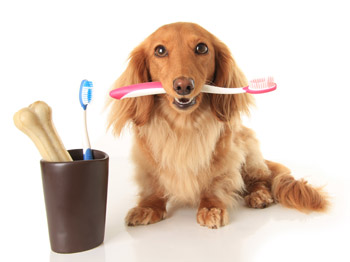
Brushing your pets teeth is one of the best ways to keep tartar and plaque away! (Image Source)

One of the most effective ways to keep our pets mouth clean is to brush their teeth. This needs to be done every 24-36 hours for maximum benefits. The good news is, they  make special toothpaste for pets that is more appealing to them (and it is ok for them to swallow). You can use any type of toothbrush. While some people prefer finger brushes, other may prefer soft bristled human tooth brushes. Either way as long as your are brushing your a helping keep tartar and plaque at bay. Probably the easiest time to start brushing teeth is when their are young so they are used to their mouth being handled, however this doesn't mean that older pets cannot be taught to tolerate regular brushing. We didn't start brushing my dog's teeth until he was about 3 years old and now he loves it! It takes time and patience but it is worth it in the end.

Dental chews have also become a very popular option to maintain good oral health. (Image Source)

Another option that is widely available are treats or chew bones that can help decrease tartar build up. A couple of things to remember is that any of these products will add calories to your pet'd diet so if they need to loose weight you will have to adjust their daily feeding schedule accordingly to account of the extra calories. You also want ot make sure you are purchasing the correct size chew for your size of pet. If a large dog gets a small dog treat they could swallow it whole or choke on pieces. This could lead to major issues in the long run and decrease in benefits, because they are not chewing it! I also recommend that you never leave pets alone with chews so you can make sure they are not swallowing small pieces and are chewing it appropriately. Overall thought, many pets really love this options to help keep their mouth healthy.


Prescription diets can also help with oral health (Image Source)

(Image Source)

There are also prescription diets that help with oral health. These include Hill's Prescription T/D and Royal Canin Dental Diet. The T/D diet has a unique kibble shape and delicious taste that promotes crunching the food and breaking down tartar. Some dogs love it so much, they think it is a treat! In fact we use this in the office as a special treat. The Royal Canin Diet is also a hard kibble that helps break down tartar but is also states it helps with digestive health.

Our pets still may need a dental cleaning, but with regular oral care at home hopefully those will occur much less!
(Image Source)

Sometimes despite our best efforts, our pets still need to have a dental cleaning performed. This is done under general anesthesia. During this time we will clean all the teeth and also probe them to assess their overall health. If any extractions are needed they can be be formed at the same time. Once the dental cleaning is done, then you have a clean slate to start one or all of the above oral health care options.

As you can imagine it would be difficult to eat with this much tartar on your teeth, and would probably not smell very good either. (Image Source)
Again, it cannot be stressed enough how important maintaining a health mouth is for a pets. With the plaque and tartar comes not only bad breathe, but also bacteria. This bacteria can lead to issues throughout other body systems including the heart and kidneys. It is extremely important to start instituting some form of health care at home for your pet. If you need ideas or any suggestions on products you can look for the VOHC (veterinary oral health council) seal. This means that the product has been studied and the claims they make on the label are verified. It is a great place to start to get ideas to keep your pet's mouth happy and healthy. You can visit their website here.

Friday, January 29, 2016

Being a Part of the Veterinary Team

Every member of the veterinary team plays and important roll! (Image Source)

As we mentioned in a previous post, there are other options in the veterinary field aside from becoming a veterinarian. Additional team members can include, certified veterinary technicians, veterinary assistants, hospital managers and kennel staff. These are the most common found support staff in the veterinary field. While there are definitely alternative careers (such as zoo keepers, lab animal assistant, etc), we will focus on the most common ones listed above.

Certified Veterinary Technicians are a huge asset to any clinic. (Image Source)

A certified veterinary technician (CVT) is invaluable to the a practice. They help support the veterinarian in almost every task. They assist with surgeries, collecting and analyzing samples, taking x-rays and any other diagnostics. As a CVT, you have a tremendous impact on the flow of the clinic and patient care. As with nurses on the human side of medicine, sometimes technicians have an even bigger impact on patient and client comfort than veterinarians do. Without CVT's the veterinarian and the veterinary profession could not function. The good news for this career path, is that the education is a lot more manageable for many people. Depending on the program you choose it can be a 2 year associates degree or a 4 year bachelor's degree. This dramatically decreases the student debt when compared with becoming a veterinarian. Many schools offer a variety of educational options as well, some have most of the class work online while others have the more standard classroom approach. Depending on your lifestyle, you can find the school that will fit your schedule and life style. There are also many options within this career path that are not limited to private practice. As a CVT, you can go on and specialize in different fields, assist with research, or any number of options. The possibilities are truly endless. If you would like more information on becoming a certified veterinary technician, you can find it by clicking here.

One job of a veterinary assistant is to restrain patients for the veterinarian to safely examine them. (Image Source) 

Another important team member is the veterinary assistant. While there is nor certification for this, there are some training options that will definitely help you become more marketable, but many people are trained on the job. Each individual practice may have different job descriptions for a veterinary assistant, but as the name states your main job will be to assist. This most often means helping with restraining patients, client communications, or possibly working with the boarding animals. This is a great way to get your foot in the door and see if the veterinary field is right for you. You can learn more about veterinary assistants here.

A practice manager will wear many hats, but be integral to the running of the clinic! (Image Source)

Practice Managers or Hospital Managers are also becoming a very common member of the veterinary team. These individuals typically deal with the business side of things, which is good because most veterinarians are not naturally business savvy. They make sure the clinic (or clinics) they oversee are running smoothly, help with personnel, sometimes ordering or delegating jobs between other team members. Their jobs can be varied and many, but they have a huge impact on helping the clinic run more efficiently, which means more pets and clients are helped every day.

As a kennel assistant, you will be able to interact closely with animals staying in the clinic. (Image Source)

Some clinics will also have dedicated kennel staff. If you like working closely with animals, this could be the position for you. Many times these will be larger facilities that house many boarding animals that will need to be cared for and exercised while their owners are away. You get to interact and have a direct impact on these pets every single day. At many clinics, these are the people that pets love and recognize the most. It can be a very rewarding position!

If you like working with animals and as a part of a team, the veterinary field may be the right choice for you ! (Image Source)

Overall, if you have a love of animals, there is definitely a position for you in the veterinary field. Examining your strengths can help you become a great member of the team. Without each member, the clinic would not run smoothly. Every single person plays an invaluable roll.

Monday, January 25, 2016

#STUFFEMMETTEATS

Emmett is a 2 year old Great Pyrenees, and he is tall enough to get to anything unattended.  This can be a pet owner’s worse nightmare.  When you have a curious puppy or young dog, there are all kinds of household hazards you need to constantly be aware of, so we are going to use Emmett’s constant escapades to help our pet owners navigate through the tricky health concerns of all puppies and young dogs.

Episode #7 Lilies

Lilies, while not at all toxic to Emmett, or your dogs, is a big toxin for our feline friends.  As the weather is hovering along at a winter extreme, many of us start indoor gardens to ward off those winter blues.  It is important to know what to look for to ensure your flowers and plants are safe for your pets.
The encounter:

A beautiful bouquet is delivered to you for Valentine’s Day.  It’s from your mom, she really loves you, and wants to make sure someone sends you flowers this year.  It has a lot of lovely flowers, and if you are anything like me, you have no idea what those flowers are.  So you get a vase filled with water, get them in there and put them on display.  They are pretty, so you put them on a table in the living room where you will get to see them often.  Your new fluffy kitten comes by, curious, later, and eats the tops of some of the flowers.  You panic, because you remember that some plants are not good for kittens, but you don’t know which ones, nor do you have any idea what type of flowers you had in the first place.

The scoop:
There are Lilies of varying types, and some lilies are harmless to cats, and others are quite dangerous.  Unless you feel confident in identifying flowers, or speak to a florist familiar with the types of lilies that are okay for cats, it might be best to avoid all types of lilies in any household with cats.
Peace lilies, Peruvian lilies, and Calla lilies, while not “safe” for cats, are much less toxic.  These types of flowers contain insoluble oxalate crystals, which can cause irritation to their mouth, and tongue, and esophagus if they eat and swallow the flowers, and symptoms are fairly mild, including drooling, pawing at the mouth, and sometimes vomiting.
The more dangerous lilies are "true lilies" of the Lilium or Hemerocallies species.  These include the tiger lily, the day lily, the Asiatic hybrid, Easter lily, Japanese Show lily, Rubrum, Stargazer, Red, Western and Wood lilies.  These are extremely toxic, and result in severe acute kidney damage and failure.  Even small ingestions can be enough to lead to significant complications, and sometimes just contact with the pollen, or water from the vase can lead to severe effects.


The plan: 

If your cat has eaten your flowers, and you are concerned that they could have been potentially toxic, seeking veterinary care immediately gives your cat the best chance at recovery.  If you are unsure which type of flower you had, bring what’s leftover of the bouquet to your veterinarian’s office for identification.  Cats that have ingested toxic lilies can be decontaminated, and hospitalized if the condition is caught early.  Your veterinarian will likely keep your cat in the hospital for several days on IV fluid therapy, while monitoring the cat’s kidney values for any changes that could indicate a problem.  Some cats can recover from this ingestion with prompt care. 


Thanks for reading and Join us next time for #StuffEmmettEats

Friday, January 22, 2016

So you want to become a veterinarian....now what?

Becoming a veterinarian is a long road but can hold many rewards! (Image Source)

Becoming a veterinarian is a popular career choice among many people, but how do you accomplish this goal?
Some days as a veterinarian can be very interesting! (Image Source)

The road to becoming a veterinarian is not a short one. It begins with a love of animals and a healthy respect for education! The typical outline for a veterinarian's education is to complete high school, then 4 years of undergraduate work, then 4 years of veterinary school. This is just for general practice, if you would like to specialize in anything there is 1 year internship and 3 year residency that will follow vet school!
There is a lot of schooling/ education that goes into becoming a veterinarian. (Image Source)

While that may be the typical track, not everyone follows this. Maybe you developed an interest in veterinary medicine after you already started a different career. You can still achieve your dream! Each school is different in the application process, but all you need to do is look up the requirements and if your previous course work in undergraduate does not match up, pursue those courses. Once that is done you can start the application process.
(Image Source)

Getting into veterinary school can be challenging as there are not as many schools as there are for medical doctors. However there are a couple of new schools in development right now which will help open more spots for future vets!
Remember all pets come with an owner! So you will need people skills to go with your education! (Image Source)

If you even think you might be interested in veterinary school you need to start by finding out if it is the right profession for you. This means spending time in a veterinary clinic. Weather it is volunteering or as an employee, you need to familiarize yourself with the day to day life of this profession and make sure it is a good fit for you. The more experiences you can get the better! Volunteering at a local shelter can also be a great way to get your foot in the door and make sure this is really something you are interested in pursuing. Make sure you talk to different veterinarians so they can  share their success stories as well as the challenges we face in this field. Make sure you keep a log of these experiences, as it will become very useful during the application process.
We can learn to treat all creatures great or small! (Image Source)

There is a lot of great information about becoming a veterinarian in this brochure.

If you don't think becoming a veterinarian is the right path for you, don't worry there are many other careers that involve animals that may be a better fit! We will discuss those next time!


Monday, January 4, 2016

New Year's Resolutions 2016

It's that time! The time when we begin to make resolutions to help lead a happier and healthier life in the coming year. It is a good time to start these resolutions with our pet as well. Here are my recommendations for some new year resolutions for our pets (my own included!)

1. Regular teeth brushing.
Getting into a brushing routine is a great resolution for 2016 (Image Source)
The mouth is the gateway to the rest of the body. If this area is dirt and filled with bacteria, that can spread to the rest of the body. Not to mention without a clean mouth, our pets' breath can really start to smell as the tartar and bacteria build up. It is recommended that the teeth are brushed daily to help cut down on tartar and plaque. There is a great website at VOHC.org that goes through products recommended by Board Certified Veterinary Dentists. Many pets will still need regular dental cleanings but if you keep up on the maintenance at home, then the time between these cleanings can start to lengthen.

2. Regular exercise
Exercise can take many forms, and you need to find what will work for you and your pet! (Image Source)
Exercise is an important part of many new year's resolution and it should become an important part of your daily routine with our pet. This goes for dogs and cats alike! Everyone needs exercise. It can help with both mental and physical health. While most of us think about taking our pets on walks for exercise, it doesn't have to always be that type of activity. You can play in the house with your pet even just in 5 minute increments, it will make both of you feel better afterwards. The general rule of thumb and goal you could set for yourself is to shoot for 1 minute of exercise/ pound of body weight. That doesn't mean a 45 pound dog needs 45 minutes of exercise all at once. It can be spread out over the course of the day. And many pets will need to work up to this amount of exercise. Again this is just a guideline, some pets will need a little less and some a little more. But make it your resolution to be active together!

3. Keeping up on grooming/ maintenance procedures.
Brushing your pet's coat is an important part of maintaining their overall health. (Image source)
This would include brushing, nail trims, ear cleaning etc. We try really hard in our house to clean ears once weekly and to try to do a full coat brushing two times a week. These are all really important maintenance items to keep our pets healthy. Nail trims can vary from patient to patient. It can depend on activity level, age and how long their quick is. Another grooming need to address would be having the anal glands checked. Some pets needs this done regularly, some never need it done. Anal glands should be expressed whenever a pet defecates but sometimes they can become impacted or infected and need to be expressed regularly. If left unattended the infection can become painful and need medical attention. All of these things can be done by a groomer, or you can learn to do them at home, or talk to your veterinarian about what the best option for your pet will be.

4. Keeping all pets on monthly flea and heartworm prevention
Giving monthly flea and heartworm preventatives is EXTREMELY important. Find a way to remind yourself each month so you don't miss a dose. (Image Source)
Fleas and heartworm are parasites that can affect both cats and dogs. Fleas are typically picked up from the environment, but even indoor cats can be affected when we track the fleas inside. Heartworms are spread by mosquitoes and travel through the blood stream and live in the heart and lungs. Fortunately there are products that can help keep our pets protected from these parasites. Most of these products need to be administered monthly. While it is easy to forget them in our busy schedules, and also preventatives are typically given monthly and are becoming very important year round. Fleas and heartworms are becoming very hearty and difficult to treat once they are established in the environment. It is much easier to prevent these two parasites then it is to treat. Many companies will send you e-mail reminders, or you can set up reminders on your phone or calendar to make sure we don't miss a dose!

5. Have fun together.
Find an activity your and your pet can enjoy together and make sure you find time to do it! (Image Source)
While pet ownership does have its challenges there are so many benefits to having a companion. Make it a priority this year to enjoy your time together. Whether it is with activities such as 5k's training classes or hiking, or just setting aside time to play with their favorite toy or just petting them anything you do together can be a lot of fun!

We hope you have a happy and healthy 2016!


Tuesday, December 1, 2015

#STUFFEMMETTEATS
Emmett is a 2 year old Great Pyrenees, and he is tall enough to get to anything unattended.  This can be a pet owner’s worse nightmare.  When you have a curious puppy or young dog, there are all kinds of household hazards you need to constantly be aware of, so we are going to use Emmett’s constant escapades to help our pet owners navigate through the tricky health concerns of all puppies and young dogs.


Episode #6 Raw Bread Dough!
Bread; completely innocuous, right?! Yes, bread dough, however, can be a problem in dogs.  The reason: yeast.
The encounter:   You are making Thanksgiving dinner.  You have put up the turkey and the stuffing, and everything else is in the oven.  There is no way your dog, Emmett, is ruining this meal.  Except for those rounds of frozen bread dough you set out to rise so you could bake them; but bread dough really doesn’t have a smell or a flavor when its frozen, so surely not a problem.  Wrong.  Unfortunately, Emmett decides he will remove the saran wrap on the dish and has gone ahead and ingested all the frozen bread dough.

The scoop:
There are several main concerns with bread and pizza dough.  If it is the kind that needs to rise, and is not just premade rolls or crust, then it contains the vital ingredient, yeast.  Yeast can do two things while sitting in your dog’s stomach; expand, and ferment.
One of the first concerns is mechanical.  Raw bread dough is meant to rise and expand, and this happening inside your dog has the potential to cause bloat.  Not only is stomach bloat painful, but with enough pressure, can cause significant pressure on other organs, including the lungs, making breathing difficult.
The secondary concern is what the yeast produces.  Yeast that is fermenting is producing both gas (CO2 gas) and ethanol (alcohol) as byproduct.  So basically, you pet can continue to have further bloating concerns with an increase of gas producing happening inside its stomach, and later start feeling like he consumed a large amount of tequila.  Unfortunately, it is hard to use the amount of bread dough as an indicator of how much ethanol or alcohol will be produced, since it is more important to know how much active yeast was in the raw bread dough.  The potential for ethanol toxicity can be life threatening.  It causes the acid level to rise in your pet’s blood stream, and causes a lot of stress to the organs as a result.  In high volumes, this can be very similar to a person suffering alcohol poisoning.

The plan:
There are a couple of things that can be done to try to halt this process before it gets out of hand.  If caught fairly early on, the stomach can be flushed and cleaned with cold water, which can help deactivate the yeast, and sometimes help flush some of the bread dough out of your pet’s stomach.  Then it is usually recommended that your pet be hospitalized with fluids and monitoring of the acid/base status of their blood.  Sometimes pain medications may be administered to help with the “hangover”.  There are cases of bread dough ingestion being fatal, very much like a severe case of alcohol poisoning in a person.   Make sure you keep the bread up somewhere away from your adventurous pooch, and consult with your veterinarian right away if you suspect this type of ingestion.


Thanks for reading and Join us next time for #stuffemmetteats


Tuesday, November 24, 2015

Thanksgiving, A time to be thankful and a time to be careful!

Turkey is a great ting for us, but can cause some stomach troubles in our pets! (Image Source)

Thanksgiving is right around the corner! With this comes great food, time with family and friends and the excitement of entering the holiday season!
There are many creative ways to show your pet your are thankful for them without giving them table food! (Image Source)

While this is such a fun and happy time for us, it is important that to remember that it can be a stressful or hazardous time for our pets! There are a few things to keep in mind to keep your holiday happy and fun!
This is a trip to the vet's office waiting to happen! (Image Source)

If you are expecting company, remember to keep your pets collar and identification on and up to date. Every time the door opens that is an opportunity for your pet to slip out! You should also pay attention to your pet's activity and body language when you have visitors. Many pets are very excited and happy to see company, however some can become stressed. It is a good idea to have a place they can go to feel safe and quiet and relax for a little while away from the buzz of activity.
Definitely not a good idea for your pet! (Image Source)

Food is usually one of the main focuses of Thanksgiving! It is a way we can all come together and celebrate. Many of the foods we will be preparing may prove to be VERY tempting even for the best behaved pet. When cooking it is a good idea to keep pets away from the kitchen. Those delicious smells could prove to be just too tempting for them! Many of the foods we are preparing could be WAY too rich for our pets leading to stomach upset. This would include the skin from turkey or of the other meats and their seasonings. Although they may give you the saddest eyes, stay strong and resist the temptation to give them table scraps! It is also VERY important to NEVER give your pets bones of ANY meat. Poultry bones are especially bad as they can splinter easily. Nothing will ruin the holiday festivities like a trip the Animal Emergency Room.
This cat will not be happy if he eats this! (Image Source)

Other foods to be careful about your pet getting into include raisins and grapes. No one know exactly why or how much of these fruits it requires, but ingestion of grapes or raisins, can lead to kidney disease very quickly in some of our pets. Another hazard is chocolate. It is the time of year where sweets are becoming very popular! Be sure to keep them away from your pets! Again, it is better for our pets to just stick with their normal diet and not make any changes, especially around the holidays.
Keep all food safely away from your pet! (Image Source)

There are many foods that can cause upset stomach or other more serious issues in our pets. We would recommend sticking with their normal diet and treats ESPECIALLY during the stressful holiday season. If you pet does accidentally get into something they are not supposed to it is best to contact your veterinarian immediately or call the ASPCA poison control  hotline.
(Image Source)

We hope you and your pets have a very Happy Thanksgiving!